
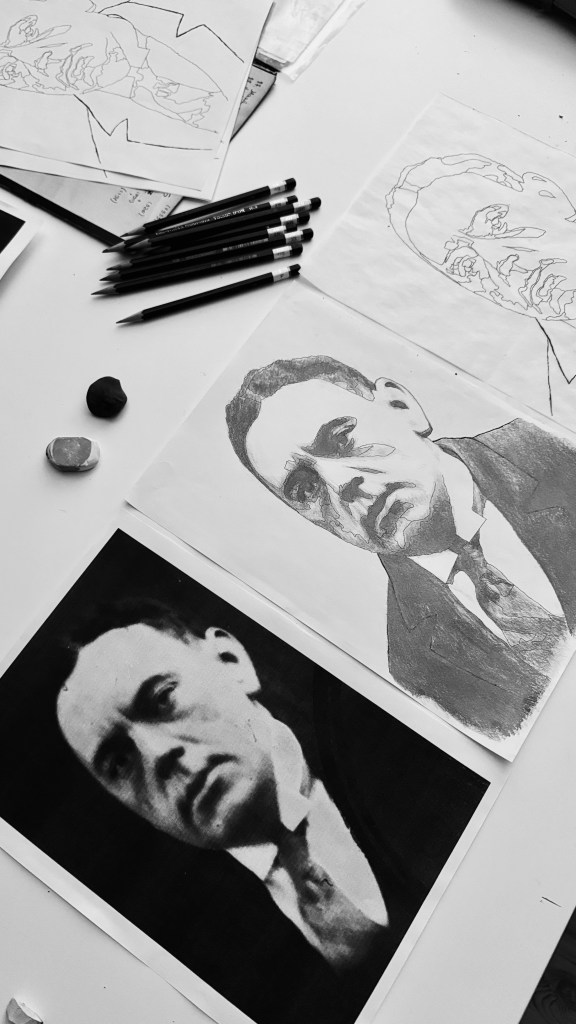
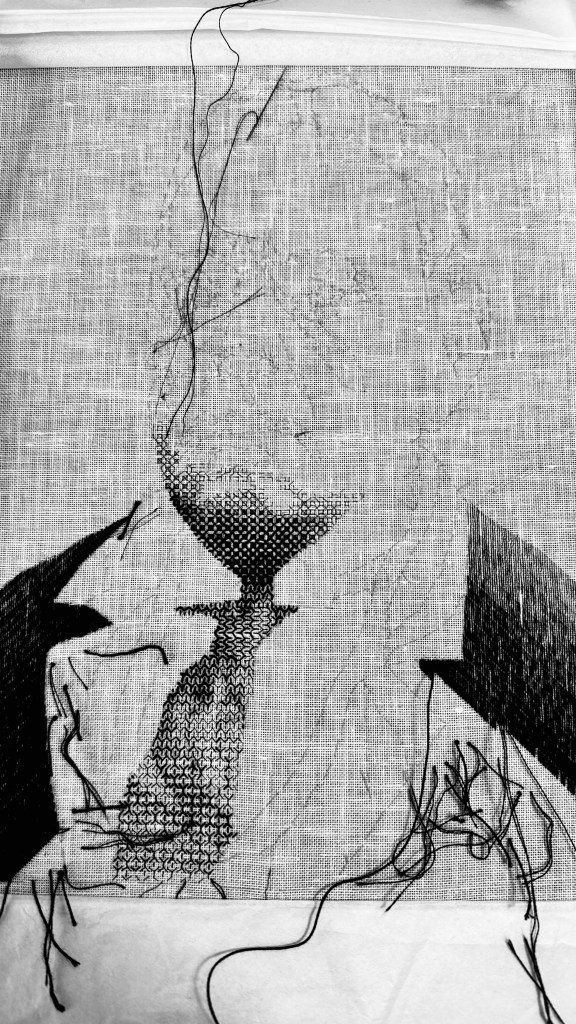

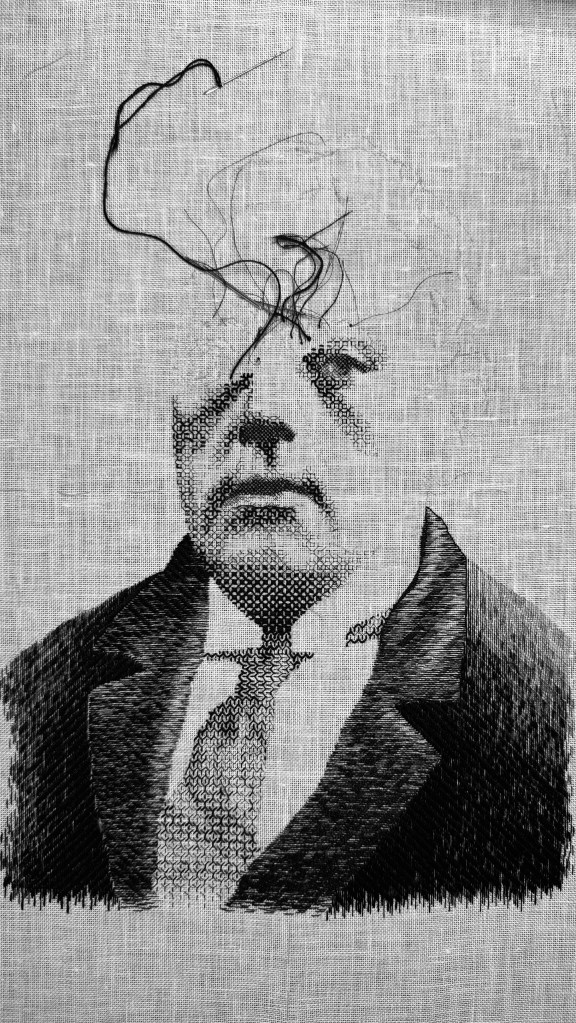
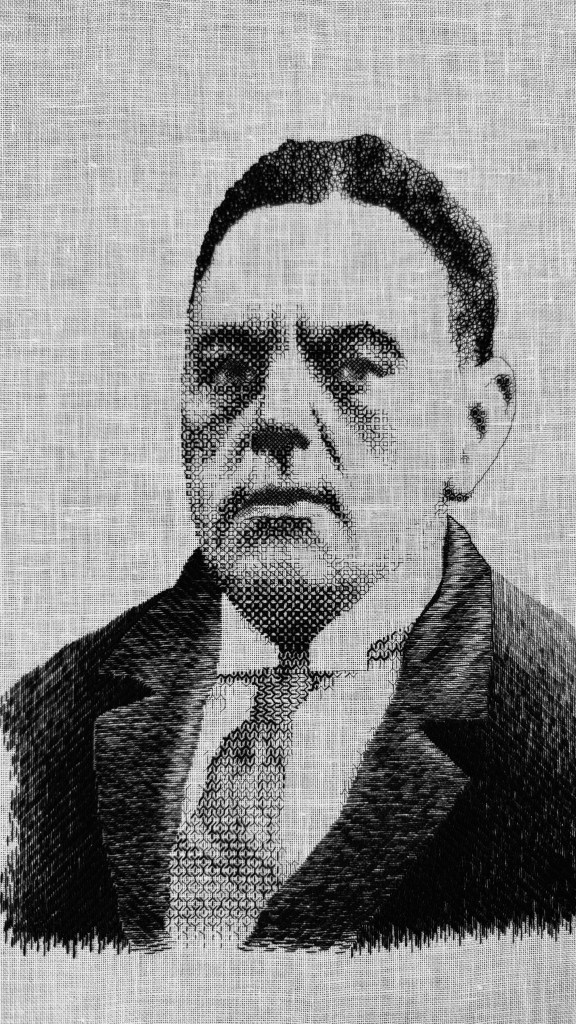
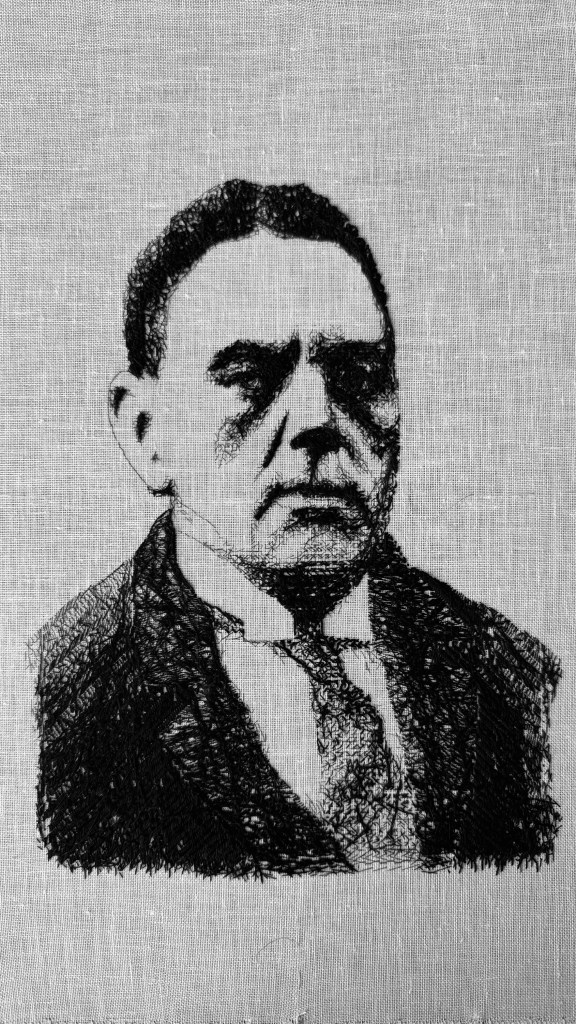
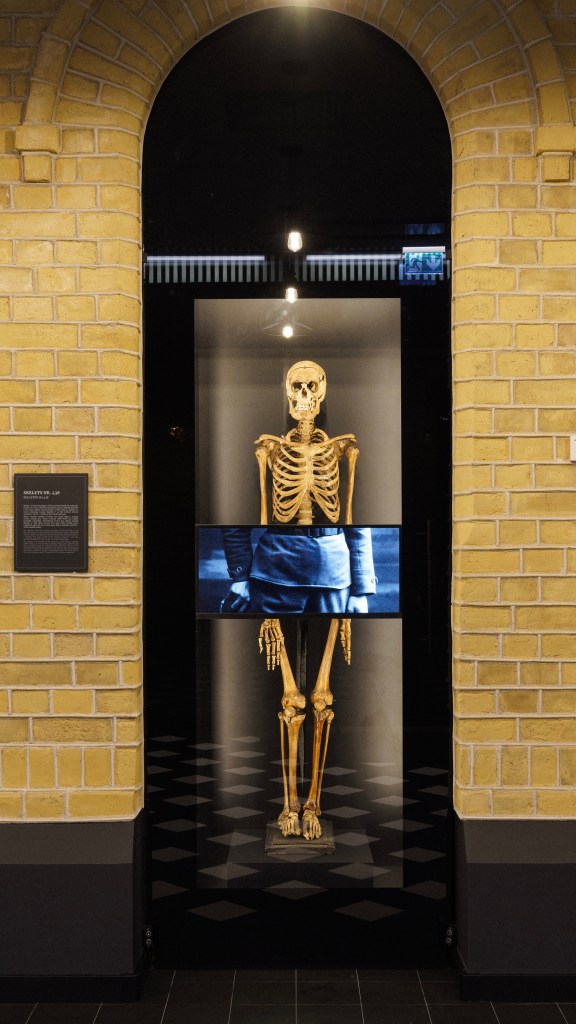
When you enter the RSU Anatomy museum in Riga, the first exhibit that greets you is a skeleton of a 27-year old male. His name is Janis Teodors Lukstins and he is the first willful donor of a human body to the museum’s collection. In a weird way he is also my coworker, being the senior colleague generously sharing a room with me. As a skeleton, he has served the museum from 1925 and his main responsibility is to remind all visitors that every exhibit at the Anatomy Museum is not only a piece of scientific heritage, but once was part of a living human body. As part of my studies at the Royal School of Needlework (UK), I decided to pay my respects and embroider the portrait of Janis Teodors Lukstins and tell his story.
This portrait has never been shown to the public before and is based on the tiny visiting card size photograph taken a few months before Lukstins committed suicide and is the last known image of him while he was alive. One of the most frequently asked questions when meeting the skeleton of Lukstins is what happened and why did he commit the suicide? Over the years, lacking real facts about him, people created their own answers and the skeleton of J.T.Lukstins got wrapped up in a bunch of legends and old wives’ tales. To find out the truth, another colleague of mine (a living one) went to the National Archives of Latvia. And this is what he discovered so far…
Janis Teodors Lukstins was born in 1898. As many young men of that time, he participated in WW1. Untypically, he fought in the south on the front against the Ottoman Empire and luckily survived the war. After WW1 he worked as an inspector in Karsava parish, but later moved to Riga where he worked at police station Nr.5. Not long after moving, on the 4th of December, 1925, he hired a horse and carriage. When he reached the corner of Valdemara and Elizabete’s street he shot himself in the head using his service weapon. Lukstins was brought to the hospital where he later died. He left a suicide note behind mentioning his last wish – after death his skeleton should be assembled and brought to the Anatomy Museum.
His last wish was granted. On 9th of December, his body arrived at the Anatomical Theater. The entry number in the cadaver register was No. 438, cause of death – ‘vulnus sclopeticum capitis’. A fairly large hole in his left template still remains, making people believe he was left-handed. Actually, that is the exit wound. After the impact with the bullet, bones from the left side of the scull went flying all over the place and couldn’t be retrieved. The bones on his right template (where the bullet entry wound is) are stapled together as they were retrieved from the inside of his scull. So why did he commit suicide?
The suicide note also stated that he committed suicide because of his unhappy family life and being tired of life. ‘Tired of life’ nowadays we most likely would call a depression or we can also speculate that he might have suffered from a form of PTSD – a common condition in war veterans. Concerning his unhappy family life – he had a wife Anna. They separated (but never divorced). Anna emigrated to the USA and nothing is known about her afterwords. Lukstins lived for a while with his mother and then moved to Riga. While working in Riga, he was falsely accused of stealing money. Janis was found not guilty only after his suicide.
People often express their surprise as “Why did he commit suicide – he was such a good-looking young man!” as if suicide and good looks have something to do with one another. The portrait I was stitching actually resulted in two portraits – the finished embroidered portrait and the other side of the embroidery that is usually covered and not often seen. It draws parallels with the persons’ facade and the inner, private world – not always known, shown or visible. Unfortunately, depression and traumatic experiences too often stay on the unseen, unknown, untold and not often spoken of side of a person.
The investigation of Lukstins’ life & death continues.
 Baiba Rieber